|
|
|
|
Popular Equipment Appraisal Searches
|

Definitions of Value Relating to Machinery and Equipment Appraisers
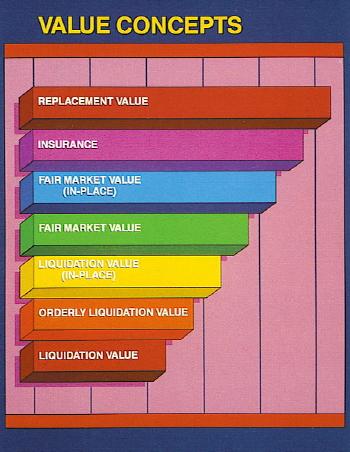
The underlying theme and elements of the machinery and equipment appraisal definitions presented here are based in standard appraisal theory. Many terms are used to describe various thoughts or premises of value. These definitions are offered to provide the fundamental value concepts; they are not the only acceptable definitions, since contracts or jurisdictions may dictate somewhat different philosophies. Therefore, these machinery and equipment appraisal definitions may be expanded or refined as the purpose and function of an equipment appraisal dictate, as long as the fundamental concepts are not altered. In other cases, the laws of a country, state, region, or regulatory agency may require other terms, which therefore would take precedence over the appraisal definitions shown here.
- Reproduction Cost New is the cost of reproducing a new replica of a property on the basis of current prices with the same or closely similar materials, as of a specific date.
- Replacement Cost New is the current cost of a similar new property having the nearest equivalent utility as the property being appraised, as of a specific date.
- Fair Market Value is an opinion expressed in terms of money, at which the property would change hands between a willing buyer and a willing seller, neither being under any compulsion to buy or to sell and both having reasonable knowledge of relevant facts, as of a specific date.
- Fair Market Value in Continued Use with Assumed Earnings Fair market value in continued use with assumed earnings is an opinion, expressed in terms of money, at which the property would change hands between a willing buyer and a willing seller, neither being under any compulsion to buy or to sell and both having reasonable knowledge of relevant facts, as of a specific date and assuming that the business earnings support the value reported, without verification.
- Fair Market Value in Continued Use with an Earnings Analysis Fair market value in continued use with an earnings analysis is an opinion, expressed in terms of money, at which the property would change hands between a willing buyer and a willing seller, neither being under any compulsion to buy or to sell and both having reasonable knowledge of relevant facts, as of a specific date and supported by the earnings of the business.
- Fair Market Value - Installed Fair market value - installed is an opinion, expressed in terms of money, at which the property would change hands between a willing buyer and a willing seller, neither being under any compulsion to buy or to sell and both having reasonable knowledge of relevant facts, considering market conditions for the asset being valued, independent of earnings generated by the business in which the property is or will be installed, as of a specific date.
- Fair Market Value - Removed Fair market value - removed is an opinion, expressed in terms of money, at which the property would change hands between a willing buyer and a willing seller, neither being under any compulsion to buy or to sell and both having reasonable knowledge of relevant facts, considering removal of the property to another location, as of a specific date.
- Liquidation Value in Place Liquidation value in place is an opinion of the gross amount, expressed in terms of money that typically could be realized from a properly advertised transaction, with the seller being compelled to sell, as of a specific date, for a failed, non-operating facility, assuming that the entire facility is sold intact.
- Orderly Liquidation Orderly liquidation value is an opinion of the gross amount, expressed in terms of money, that typically could be realized from a liquidation sale, given a reasonable period of time to find a purchaser (or purchasers), with the seller being compelled to sell on an as-is, where-is basis, as of a specific date.
- Forced Liquidation Value Forced liquidation value is an opinion of the gross amount, expressed in terms of money, that typically could be realized from a properly advertised and conducted public auction, with the seller being compelled to sell with a sense of immediacy on an as-is, where-is basis, as of a specific date.
- Salvage Value Salvage value is an opinion of the amount, expressed in terms of money that may be expected for the whole property or a component of the whole property that is retired from service for possible use elsewhere, as of a specific date.
- Scrap Value Scrap value is an opinion of the amount, expressed in terms of money that could be realized for the property if it were sold for its material content, not for a productive use, as of a specific date.
|
EQUIPMENT APPRAISAL BY CITY SEARCH
|
|
ACCREDITED MACHINERY APPRAISERS | USPAP COMPLIANT International Appraisals, Inc.
Ronald J. Savill, ASA, MRICS
David L. Strange, ASA, MRICS
Phone: 866.932.3300
Fax: 866.932.3331
Email: intappraise@aol.com
Accredited machinery and equipment appraisals for the following States: Alabama, Alaska, Arizona, Arkansas, California, Colorado, Connecticut, Delaware, Florida, Georgia, Illinois, Indiana, Iowa, Kansas, Kentucky, Louisiana, Maryland, Michigan, Minnesota, Missouri, Nevada, New Jersey, New York, North Carolina, Ohio, Oklahoma, Pennsylvania, Rhode Island, South Carolina, Tennessee, Texas, Utah, Virginia, Washington, Wisconsin.
USPAP compliant machinery and equipment appraisals in the following Cities: Albuquerque, Amarillo, Austin, Atlanta, Birmingham, Boise, Boston, Chicago, Cheyenne, Cincinnati, Cleveland, Dallas, Denver, Detroit, El Paso, Eugene, Fresno, Fort Myers, Grand Rapids, Houston, Indianapolis, Kansas City, Las Vegas, Los Angeles, Louisville, Memphis, Miami, Nashville, New York City, Oakland, Orange County, Orlando, Philadelphia, Phoenix, Reno, Sacramento, Salt Lake City, San Antonio, San Diego, San Francisco, Spokane, St. Louis, Seattle, Stockton, Tallahassee, Tampa, Tucson, Tulsa, San Juan, Puerto Rico
Serving Clients with machinery and equipment appraisals for:
Medical Equipment Appraisals | Construction Equipment Appraisals|
Restaurant Equipment Appraisals | Plastic Machinery Appraisals |
Hospital Equipment Appraisals | Woodworking Machinery Appraisals |
Metalworking Machinery Appraisals | Sheet Metal Fabricating Appraisal | CNC Machinery Appraisals | Office Equipment Appraisals |
Desktop Equipment Appraisals | Desktop Machinery Appraisers | Onsite Equipment Appraisals
|
|
|
|
|
|